AI Pilots Were Dying in 2025. In 2026 CEOs Are Taking Charge
MIT found that 95% of AI pilots failed in 2025, undone by poor workflow fit, over-customization, and building instead of buying. In 2026, AI spending is doubling and CEOs, not CIOs, are taking ownership, with half saying their job is on the line if it doesn't pay off.

In July of 2025, MIT released a report called The GenAI Divide, which uncovered some sobering facts on AI adoption. They found that 95% of AI pilot programs fail, and they often fail for the same underlying reasons
- Poor workflow integration — Tools don’t plug into existing systems or match how teams actually work day-to-day, so they feel brittle and misaligned.
- Excessive customization/setup burden — Tools requiring heavy enterprise configuration tend to stall at the pilot stage, while low-setup tools with fast, visible value succeed.
- Building internally instead of buying — Internal builds failed roughly twice as often as external partnerships (~33% vs ~67% deployment success).
- Investment misallocation — ~50% of budgets flow to visible sales/marketing use cases where metrics are easy to attribute, while less trackable but more impactful back-office opportunities stay underfunded.
Interestingly, this study found that even power users of general-purpose AI tools were generally skeptical of tailored and purpose-built AI systems, citing them as brittle and lacking the iterative feedback loop common in the general-purpose AI tools they used on a daily basis. This has led to a phenomenon called “Shadow AI”, which is when workers employ personal or unapproved AI tools to accelerate their work, rather than purpose-built AI tools developed or invested in by the company.
95% of AI pilots failed because of these shared characteristics. The 5% of pilots that were successful also had a shared set of characteristics. For buyers, these characteristics were:
- Success stories come from buying over building: The overwhelming majority of success stories were made out of a partnership between partners with technical expertise, and businesses with specific domain expertise
- Good buyers treat partners like partners, not SaaS vendors: Success stories in AI alignment stem from buyers and partners working together to iteratively understand and build systems, rather than providers of a general Saas product. This allows both parties to iterate on the core problem and weather the inevitable challenges of AI integration.
- Successful buyers get inspiration from the front lines: Instead of top-down initiatives from AI labs, successful buyers let domain managers and power users surface use cases and lead rollouts. This allowed buyers to pursue operations ROI that drive tangible value, not just visible wins with more optics than impact.
The characteristics of successful sellers echoed those of successful buyers:
- Focus on narrow, integrated, immediately valuable problems, with minimal integration cost: Successful firms were specialists, rather than generalists. They found specific and high-value problems that could be solved with AI systems, and integrated with customers to develop specific workflows that were heavily customized
- Grow through referral networks and domain fluency: After achieving success within particular engagements, a small number of firms grew laterally through referral and trust, allowing them to cut through an increasingly saturated space of competitors failing to gain traction through traditional marketing approaches.
This quote from the 2025 MIT report summarizes their findings best.
Across our interviews, we observed a growing divergence among GenAI startups. Some are struggling with outdated SaaS playbooks and remain trapped on the wrong side of the divide, while others are capturing enterprise attention through aggressive customization and alignment with real business pain points. — Source
Despite 95% of pilots failing in 2025, it appears the industry has observed and taken note of the 5% of successes. In 2026, spending on AI initiatives has doubled, and hope is rising. Based on a report by the Boston Consulting Group, it appears a fundamental mechanism of this newfound excitement is an increasing tendency of CEOs, rather than CIOs, to own corporate transformations.
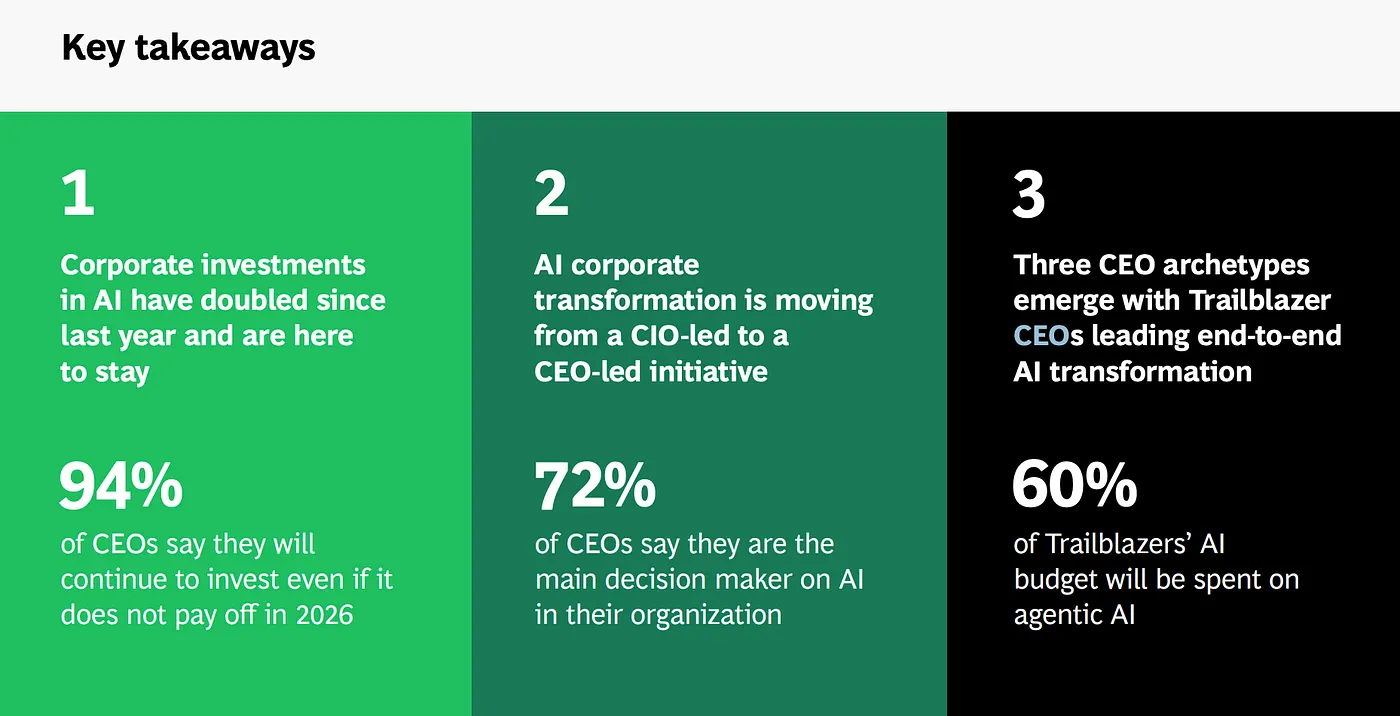
Image source
This transformation makes sense when you consider how large these transitions are, and how much they impact the core functions of a company.
CEOs are recognizing that AI is more than a technology. It opens the door to a fundamentally different way of running organizations — touching strategy, operations, culture, risk, and talent. In close coordination with their executive team, the CEO is the executive with the authority and perspective to connect those organizational and management dots. — Source
This is exciting, but the chips are on the table, and with CEOs taking ownership, it’s their necks on the chopping block.
With so many CEOs taking ownership of the success of their AI initiatives, AI is poised for a consequential year in 2026. So consequential, in fact, that half of CEOs believe that their job is on the line if AI does not pay off. — Source
Here’s the uncomfortable takeaway for any executive now personally on the hook for AI: the failures weren’t about the models. They were about integration, focus, and choosing to build what you should have bought. The 5% that worked did the opposite.
Valantor turns the documents your business already runs on into trusted, verified intelligence, deployed inside the tools your teams live in and the infrastructure your compliance team demands. We specialize in working directly with customers to turn complex documents into robust and scalable AI systems. If you want to be part of the 5%, then bring us your hardest documents and book a demo.